A semiconductor chip no larger than a fingernail contains tens of billions of transistors. Circuit line widths have already shrunk to the nanometer (nm) scale, where even variations of just a few atoms can affect product performance and quality. As high-performance semiconductors for AI servers, HBM (High Bandwidth Memory), and advanced packaging technologies rapidly advance, semiconductor structures are becoming finer and more complex.
The smaller the circuits, the more important cleaning and drying become. Even a single particle just a few nanometers in size or trace metal ions dissolved in water can interfere with transistor operation and affect the yield of an entire wafer.
In semiconductor manufacturing, thoroughly cleaning wafers and drying them without a trace is therefore as important as forming the circuits themselves. At the final stage of cleaning, high-purity IPA (High Purity Isopropyl Alcohol) for semiconductor cleaning displaces water and evaporates without a trace.
Three Cleaning Challenges of Miniaturization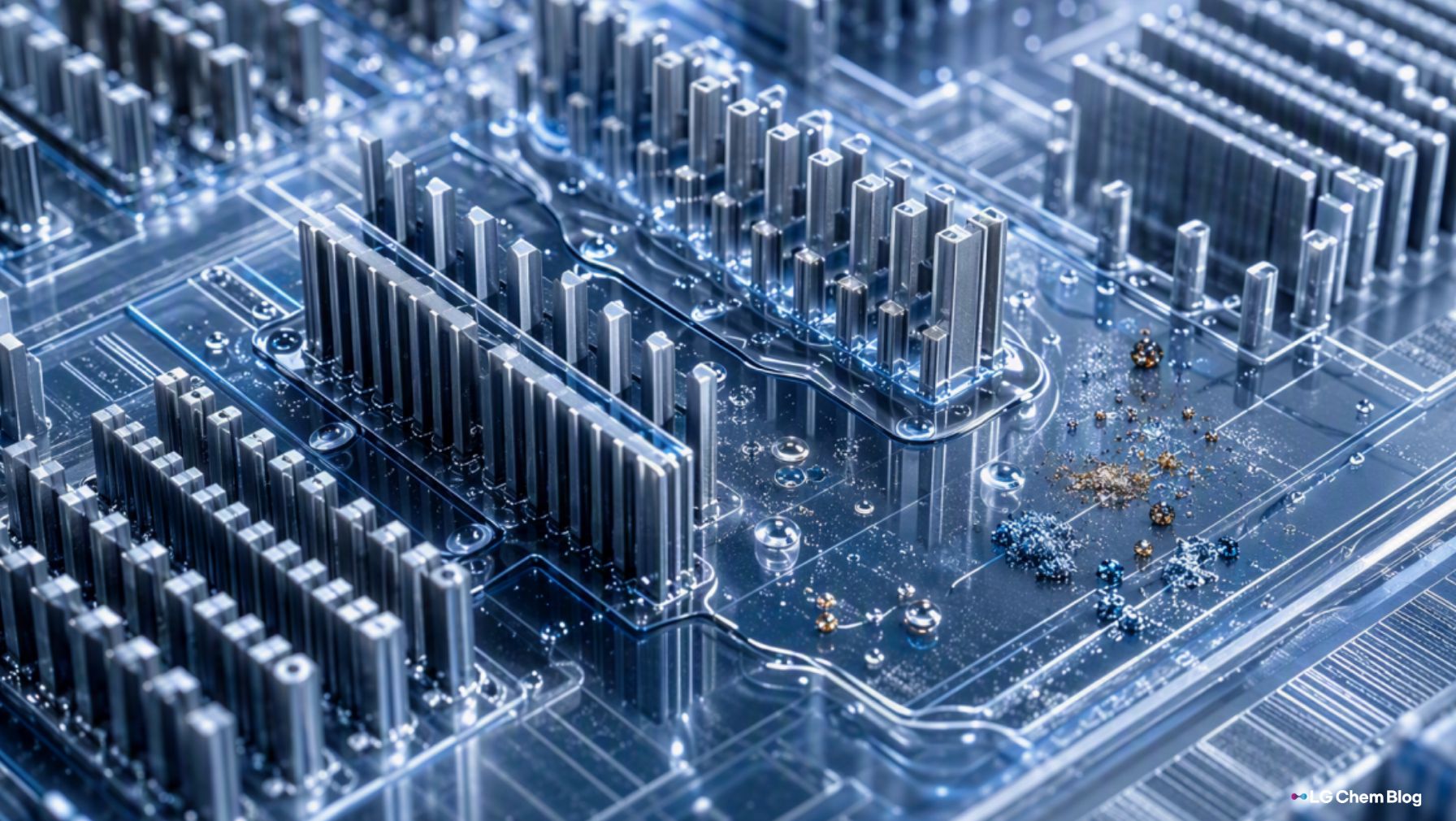
As semiconductor processes become finer, cleaning and drying conditions become more demanding. The main challenges are pattern collapse, watermarks and residues, and metal contamination.
■ Pattern Collapse
Narrow, tall structures are densely packed on the wafer surface. As circuit line widths shrink while structure heights remain the same or increase, pattern aspect ratios become higher. When cleaning liquid remains between the structures and evaporates, surface tension creates *capillary force that exerts a pulling force on the pattern walls. The thinner and taller the structures, the harder it is for them to withstand this force, causing patterns to stick together or collapse.
■ Watermarks and Residues
If water remains on the wafer surface after cleaning and dries, it can leave watermarks. Even microscopic watermarks can affect subsequent deposition or lithography processes and cause defects. Components that do not evaporate easily can also remain during drying, turning the cleaning solution itself into a source of contamination.
■ Metal Contamination
Even trace metal ions can alter the electrical properties of semiconductor devices. Alkali metals such as sodium and potassium can migrate through insulating layers and change transistor operating voltages, while iron and copper can cause leakage current in silicon. Semiconductor processes control metal contamination beyond ppb(parts per billion) down to ppt(parts per trillion) levels. This is why the purity of cleaning chemicals directly affects semiconductor yield and reliability.
Supply stability is also critical. Semiconductor *fabs operate 24/7, and switching to an alternative material requires a lengthy evaluation process. To be used in actual semiconductor processes, materials must therefore be supplied reliably, at consistent quality, whenever needed.
* Capillary force: Force caused by liquid surface tension and liquid-solid interactions in narrow gaps or between microstructures.
* Fab: A semiconductor manufacturing facility where circuits are formed on wafers through processes such as cleaning, etching, and deposition.
Why IPA Replaces Water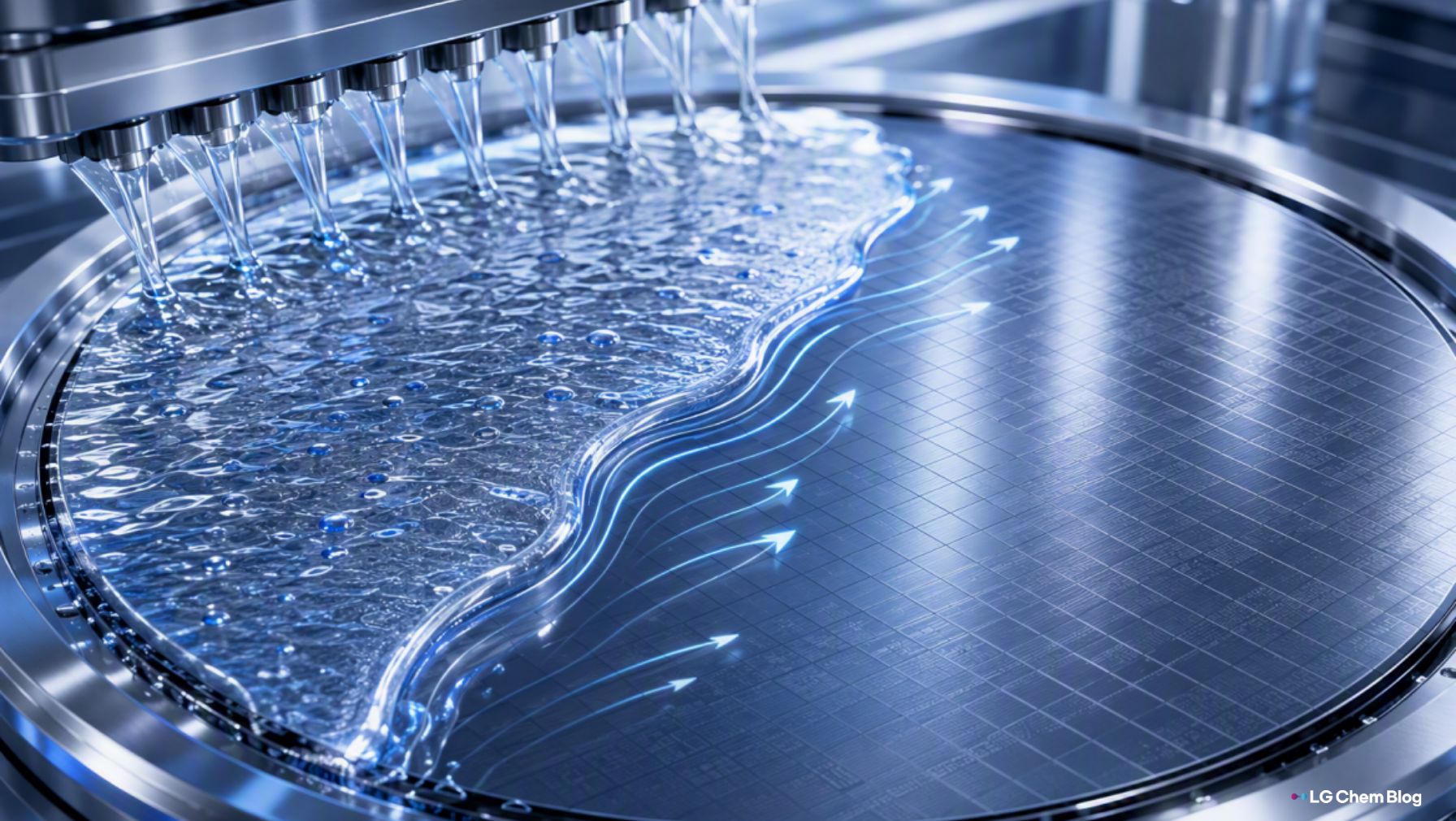
IPA (Isopropyl Alcohol) is a colorless, volatile liquid with the chemical formula (CH₃)₂CHOH. IPA has long been used in semiconductor cleaning and drying because of three key properties:
• High miscibility with water
• Low surface tension
• Rapid evaporation
First, IPA mixes with water in any proportion, allowing it to displace water remaining on a wafer after cleaning with ultrapure water (DI Water).
At room temperature, IPA has about one-third the surface tension of water. Because the capillary force that causes pattern collapse is proportional to liquid surface tension, replacing water with IPA reduces the force on fine structures.
IPA also has a low boiling point of about 82.6°C and evaporates quickly at room temperature. Its ability to evaporate without leaving traces after cleaning and water displacement is essential for a drying material.
These properties are used in IPA vapor drying and Marangoni drying. In Marangoni drying, IPA is supplied to water on the wafer surface, creating a surface-tension difference that moves the water toward the wafer edge. Because the water moves away instead of evaporating directly from the surface, both watermarks and pattern collapse can be reduced.
The Same IPA, Completely Different Control Standards
IPA used as rubbing alcohol and the other used for semiconductor cleaning are chemically the same substance, but they require entirely different levels of quality control.
General industrial IPA can serve as a solvent for dissolution, dilution, and general cleaning at about 99.5% purity. Semiconductor-grade high-purity IPA, however, requires control not only of purity but also of what is contained in the remaining 0.01% of composition.
| Category |
General Industrial IPA |
High-Purity IPA for Semiconductor Cleaning |
| Primary Role |
Dissolution, dilution, general cleaning |
Water displacement, precision cleaning and drying |
| Control Items |
Primarily purity and water content |
Purity, water content, NPA, IPE, acetone, metal cations, anions, acidity, residue on evaporation, etc. |
| Control Units |
%~ppm |
ppm~ppt |
| Evaluation Criteria |
Performance as a solvent |
Zero-residue performance on the wafer surface |
Key control items for semiconductor-grade high-purity IPA include NPA (n-Propyl Alcohol), metal cations, and water. NPA has a higher boiling point than IPA and evaporates more slowly. If concentrated on the surface near the end of drying, it can cause residue or drying stains. Metal cations can directly alter the electrical properties of semiconductor devices, causing leakage current and degraded insulation. For this reason, they are controlled down to ppt levels. Water can also increase surface tension, raising the risk of watermarks and pattern collapse.
Ultimately, semiconductor-grade IPA is judged less by “how pure it is” than by “what it does not leave behind.” The types of impurities controlled and their control levels determine the IPA grade.
What Customers Look for in High-Purity IPA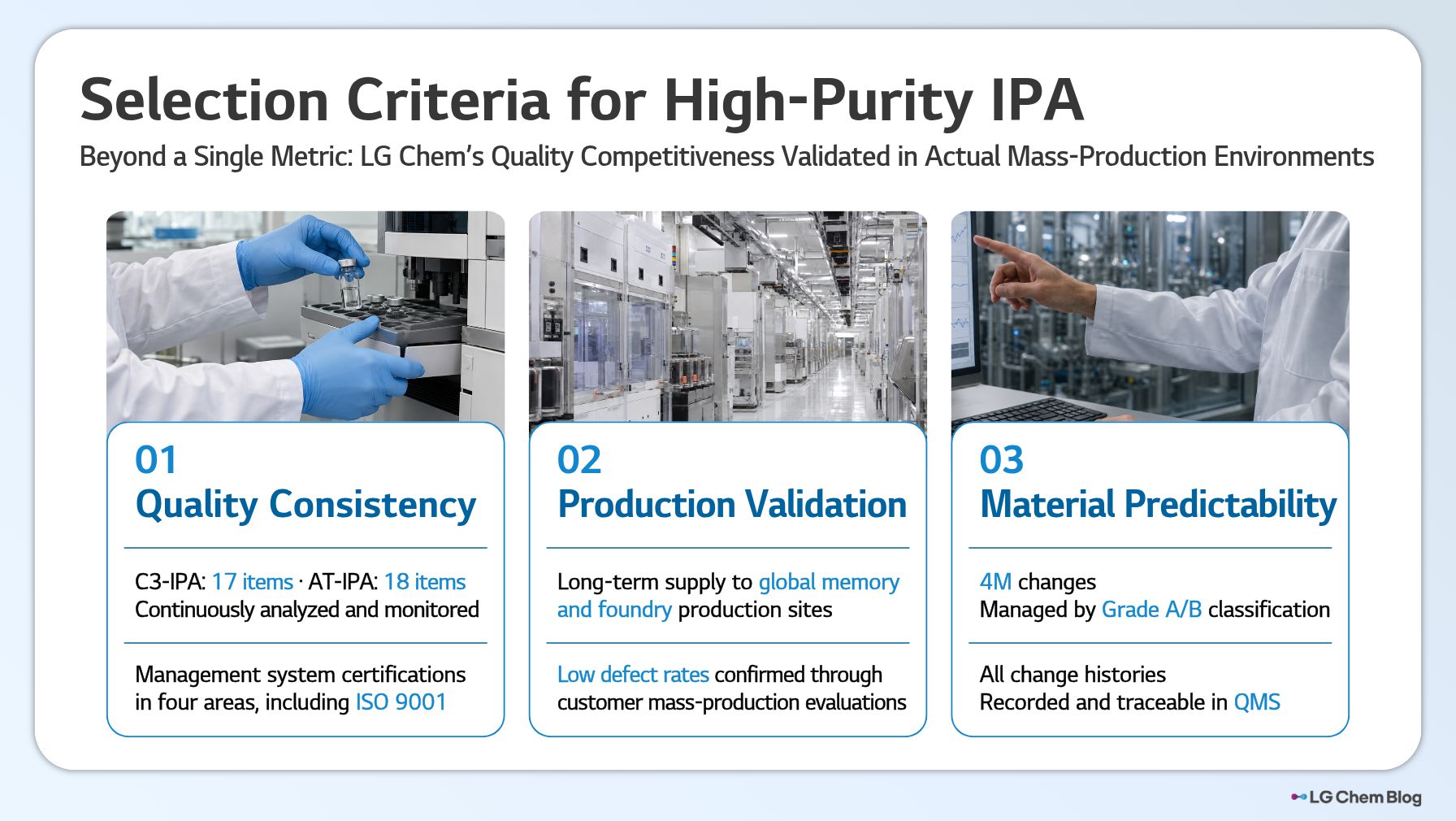
When semiconductor customers evaluate IPA, they look beyond a single value on a certificate of analysis and consider quality consistency for stable fab use, mass-production experience, and systematic change management.
■ Quality Consistency
Semiconductor process conditions are precisely optimized for approved materials. Even small variations in material properties can therefore cause process variation and yield fluctuations.
LG Chem continuously analyzes and manages 17 quality items for C3-IPA and 18 for AT-IPA. Its Yeosu Plant also holds management system certifications in four areas—quality, environment, occupational health and safety, and energy—including ISO 9001.
■ Mass-Production Validation
Changing a material in a semiconductor fab is a major risk. Even if analytical results are strong, actual performance on a production line must be confirmed through customer evaluation.
LG Chem’s high-purity IPA has long been supplied to production sites with stringent quality standards, including global memory semiconductor and major foundry customers. Customer evaluations in actual mass-production environments have also shown low defect rates, demonstrating its quality competitiveness. LG Chem continues to improve IPA quality through investments in purification columns and analytical equipment.
■ Material Predictability
If a material changes after a lengthy approval process, customers may have to review all process conditions again. LG Chem uses its 4M (Man, Machine, Material, Method) change management system to manage changes in materials and production by impact level. Changes requiring customer evaluation or approval are classified as Grade A, while those requiring prior notification are Grade B. Changes are reviewed by the Change Management Committee and discussed with customers in advance. All change histories are recorded in the Quality Management System (QMS) for traceability.
Based on this quality management system, LG Chem offers three IPA grades: AT-IPA for non-semiconductor applications, C3-IPA for semiconductor applications, and HP-IPA for high-purity semiconductor processes.
- AT-IPA: Produced from acetone and used in paints, inks, general cleaning agents, and other applications.
- C3-IPA: Produced by reacting propylene with water. Low levels of impurities such as NPA and water make it suitable for semiconductor applications.
- HP-IPA (High Purity IPA): Further purified from C3-IPA and used in processes requiring the highest cleanliness, such as wafer cleaning and drying.
FAQ
Is disinfectant alcohol the same substance as IPA used for semiconductor cleaning?
Disinfectant alcohol uses either IPA (isopropyl alcohol) or ethanol as its main ingredient, so it is not always the same substance as semiconductor-grade IPA. However, if the disinfectant is IPA-based, the basic chemical substance is the same. Disinfectant alcohol is typically diluted with water to enhance its antimicrobial effectiveness, whereas high-purity semiconductor-grade IPA is subject to extremely strict controls for purity, water, metal ions, and other trace impurities to prevent wafer defects.
If the purity is 99.98% versus 99.99%, isn’t the difference negligible?
In semiconductor processes, the composition of the remaining 0.01–0.02% matters more than the purity figure itself. Even at the same purity, process impact can vary depending on NPA content or the presence of metal ions. That is why LG Chem manages 17–18 quality items for each product in addition to purity. NPA, in particular, is controlled at about 3 ppm.
How is IPA classified according to raw material and purification level?
LG Chem’s IPA is classified into AT-IPA, C3-IPA, and HP-IPA. AT-IPA is produced from acetone and used in non-semiconductor applications such as paints, inks, and general cleaning agents. C3-IPA is produced by reacting propylene with water and is used in semiconductor applications because of its low impurity levels. HP-IPA is further purified from C3-IPA and used in processes requiring high cleanliness, such as wafer cleaning and drying.
Can changes in material production conditions be reviewed in advance?
LG Chem manages all changes through its 4M change management system. Changes requiring customer evaluation or approval are classified as Grade A and must undergo prior consultation and customer evaluation. Changes requiring notification are classified as Grade B. All change histories are recorded in the Quality Management System and are fully traceable.
In semiconductor processes, IPA neither forms circuits nor becomes part of semiconductor devices. It quietly evaporates after the wafer has been thoroughly cleaned. Yet in semiconductor manufacturing, leaving nothing behind—and doing so with consistent quality every time—directly determines yield and reliability.
As circuit line widths shrink, these requirements become more demanding, and standards for cleaning materials continue to rise. Backed by more than 30 years of IPA production experience, a dual raw-material base of acetone and propylene, and stable supply from three plants, LG Chem supports customer yield and process stability.
LG Chem will continue investing in purification facilities and analytical capabilities to provide high-purity material solutions for increasingly fine semiconductor processes.
※Some images in this content were generated using AI.





There are no comments yet! Be the first to let us know your thoughts!