As AI and HPC(high-performance computing) continue to advance, the semiconductor industry is approaching a new turning point. As data processing increases, chip and package structures are becoming more complex, highlighting the growing importance of the materials technologies that support them.
In this interview, we speak with the CCL(Copper Clad Laminate) development team, a key material in semiconductor packaging, to discuss their technology direction and its significance.
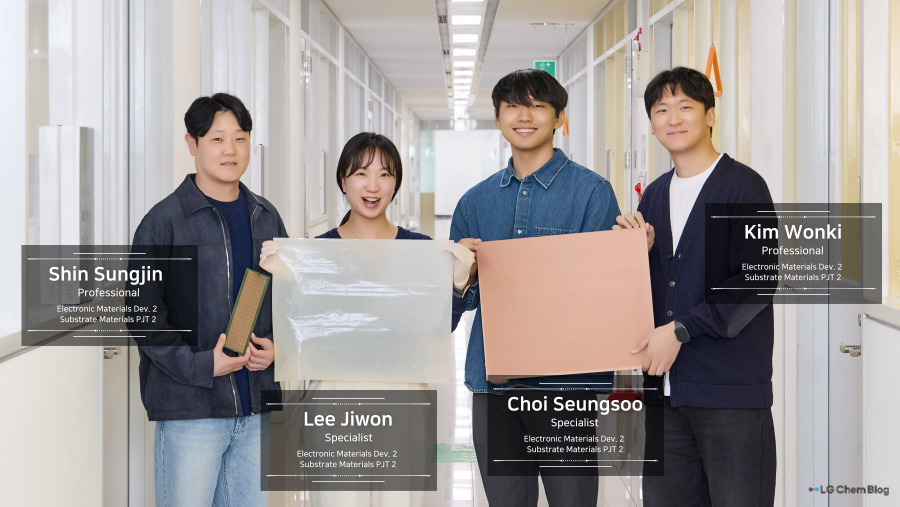
Hello! Could you briefly introduce your team’s role in CCL development at LG Chem?
Our team is dedicated to the development of advanced CCL solutions. We develop CCL optimized for high-performance semiconductor packages used in AI servers and HPC systems. By identifying and combining a range of thermosetting resins, we design material systems that meet key technical requirements such as low loss, high heat resistance, and controlled thermal expansion.
In this role, we develop core materials that determine signal quality and reliability in semiconductor packages.

Could you explain the role of CCL from a semiconductor packaging perspective?
CCL is a core material in semiconductor package substrates. It serves as the pathway for electrical signals, a protective layer for chips, and the structural base of the substrate. Higher-quality CCL improves semiconductor performance and enables faster and more stable signal transmission.
CCL provides the base that allows semiconductor chips to operate properly. Even high-performance chips require a stable substrate to support and connect them. As the base material of the substrate, CCL supports accurate signal transmission and protects chips from heat and external environments.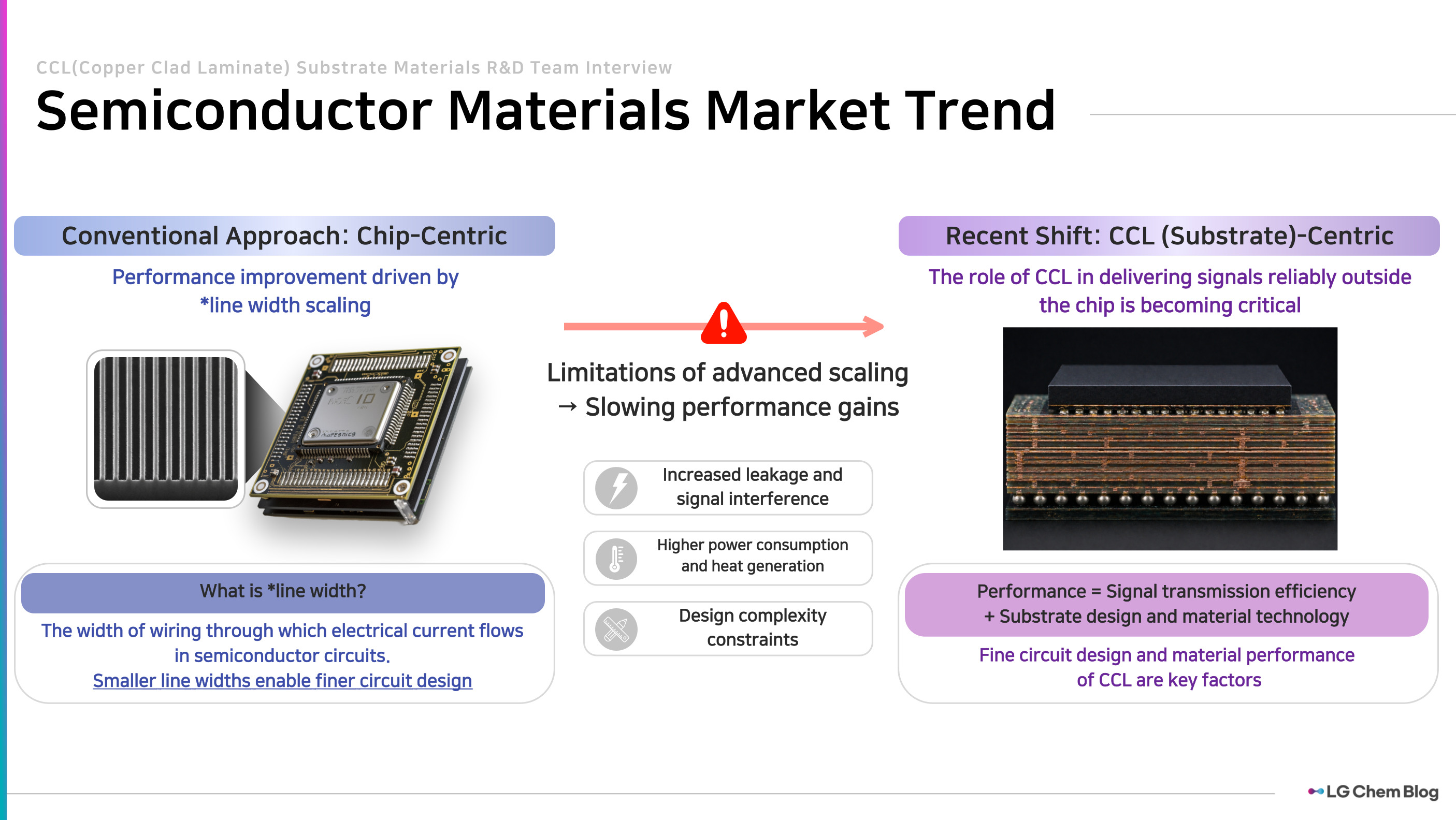
Why is the importance of the CCL business increasing,
and what role does it play in semiconductor packaging?
LG Chem views the CCL business important, as the driver of semiconductor performance improvement is shifting from the chip to the substrate.
In the past, reducing the line width of circuits within the chip was the key method for improving performance. As this approach approaches its physical limits, the role of the substrate that transmits signals from the chip is becoming more important.
In particular, CCL, which functions as an insulating material, is becoming a key factor that determines semiconductor performance.
As AI and HPC applications require larger data processing capacity, chip structures are becoming larger and more complex. This increases the distance that signals must travel, making the role of the substrate more important. These changes increase both the complexity and importance of CCL design.

Demand for high-performance semiconductors across AI, servers, and mobile is rapidly increasing.
In this context, what technical changes and key requirements are emerging for CCL?
In the AI era, CCL must support fast and accurate signal transmission while controlling heat and deformation.
Key requirements include:
Low dielectric constant and low loss
Low Dk / Low Df |
High heat resistance
High Tg |
Thermal conductivity |
Ultra-fine circuitry and high-density stacking |
Expansion of New material applications |
| Minimizes signal loss and ensures high-frequency stability |
Ensures stability under high-temperature processes |
Improves heat dissipation and supports control of coefficient of thermal expansion (CTE) |
Supports fine circuit implementation and dimensional stability |
|
As these diverse requirements continue to advance simultaneously, CCL is evolving into a material that integrates signal, thermal, and structural design. Ultimately, it serves as a foundation for ensuring stable semiconductor performance.

In response to these market changes,
which technology areas is LG Chem’s CCL development team focusing on?
*FCBGA substrates are relatively thick and large, making them prone to deformation whenwhen subjected to heat.
To address this, we are focusing on the development of CCL with low coefficient of thermal expansion (low CTE) to minimize deformation.
In addition, as semiconductor performance advances, circuits become increasingly fine and densely integrated, leading to greater signal interference. To mitigate this, we are also focusing on developing materials with low dielectric constant and low loss characteristics to reduce interference and improve signal transmission speed.
*FCBGA(Flip Chip Ball Grid Array): A semiconductor package structure that connects the chip directly to the substrate and transmits signals through solder balls

What is the key strength of LG Chem’s CCL?
The key differentiator of LG Chem’s CCL is reliability. Through *bHAST reliability testing, LG Chem’s CCL demonstrates long-term reliability under high-temperature and high-humidity conditions. It has been applied to automotive electronics and SOCAMM (server and AI high-performance package) applications, validating product stability and durability.
This reliability is built on years of accumulated expertise in resin, filler, and lamination processes, as well as tailored material design that reflects customer environments and package structures. It also reflects integrated optimization across material and process from development to mass production.
Ultimately, the strength of LG Chem’s CCL lies not only in enabling high performance, but in securing material reliability that enables stable operation over time in actual customer package environments.
*bHAST: An accelerated reliability test that applies voltage under high-temperature and high-humidity conditions to evaluate long-term product reliability
Where is LG Chem’s CCL applied, and how do requirements differ by application?
LG Chem’s CCL is widely used in high-value semiconductor packaging across memory, mobile, automotive, and server applications.
In particular, it holds the leading global market position in DDR5 substrates for PC and server applications, while continuously expanding its presence in mobile and automotive memory. The company is also broadening its footprint into non-memory substrate markets, which have traditionally been led by Japanese companies.
Performance requirements vary by application. For example, server substrates require fast and accurate signal transmission, with low signal loss and high structural stability to prevent warpage. LG Chem’s CCL has earned strong market recognition for these capabilities, enabling the company to maintain a leading market position.
Mobile and automotive substrates operate under diverse environments and structures, where heat resistance and long-term reliability are critical. LG Chem addresses these requirements by segmenting its products and providing materials optimized for each application.
What was the most challenging technical issue in developing CCL?
How did the team approach solving it,
and are there any memorable collaboration experiences you can share?
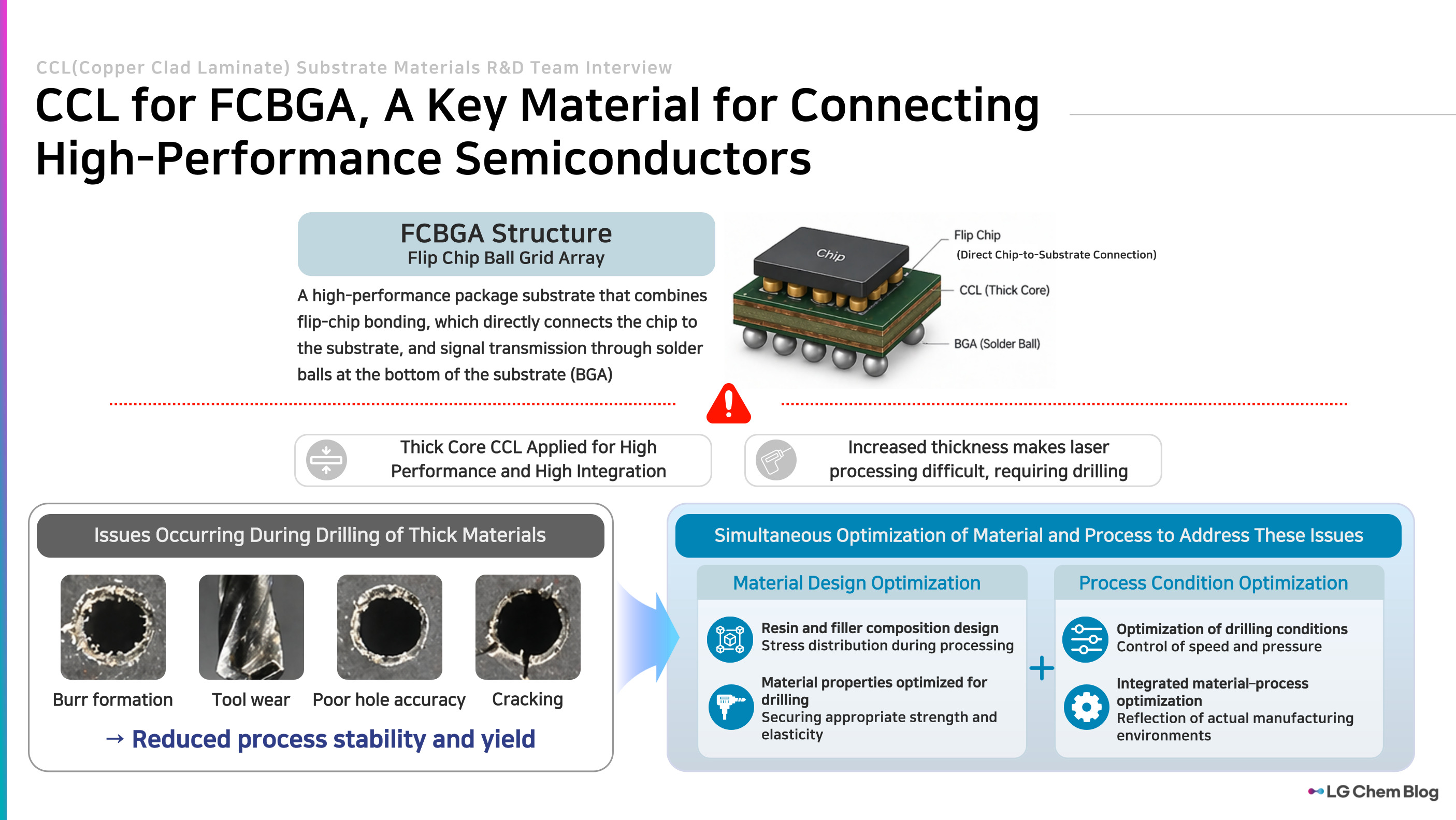
One of the most challenging issues in developing CCL was improving the processability of thick-core CCL for FCBGA.
FCBGA CCL uses a thick structure to connect the chip and the substrate. As a result, drilling – rather than laser processing is required to form fine holes.
During drilling, quality issues can occur, such as burr formation around the holes, rapid tool wear, misalignment, and cracking. These issues directly affect process stability and yield.
To overcome these challenges, we redesigned the material itself. By adjusting resin and filler composition, we distributed the stress generated during processing and designed material properties with appropriate strength and elasticity for drilling. We also optimized both material and process conditions by reflecting actual manufacturing environments.
As a result, we developed thick-core CCL for FCBGA that meets requirements for processability, reliability, and mass production.

As semiconductor packaging technologies continue to advance, how do you expect CCL to evolve?
In addition, what technology directions or strategies is LG Chem preparing to respond to these changes?
As semiconductor packaging technologies continue to advance, CCL is evolving to simultaneously meet increasingly demanding requirements, including high-frequency and high-speed signal transmission, ultra-thin and large-area substrate design, as well as high heat resistance and reliability.
In particular, as advanced packaging technologies such as AI, HPC, 2.5D/3D packaging, and chiplet-based architectures become more widely adopted, CCL is moving beyond a simple insulating substrate to become a core platform material that influences signal integrity (SI), power integrity (PI), thermal management, and warpage control.
To address these changes, LG Chem is strengthening high-speed signal transmission performance through low dielectric constant (Dk) and low loss (Df) material design, while advancing technologies to control warpage through low CTE and low stress properties. In addition, based on ultra-thin substrate technologies and high heat-resistant, high-reliability resin systems, LG Chem continues technical validation and mass production readiness with global high-end packaging customers.
Furthermore, building on its strong foundation in memory applications, LG Chem is expanding its portfolio into AI and non-memory packaging materials, while strengthening customized CCL solutions optimized for customer requirements and package structures.
Finally, do you have any remarks you would like to share?
LG Chem continues to support semiconductor performance through CCL materials amid rapidly evolving market demands.
We will continue to develop materials that deliver both high performance and reliability, ensuring stable operation in real customer environments.
As highlighted throughout this interview, the competition for semiconductor performance is expanding beyond the chip to the packaging level, increasing the importance of substrate and material technologies.
LG Chem will continue to provide CCL materials that deliver reliable performance based on its expertise in material design and process optimization.





There are no comments yet! Be the first to let us know your thoughts!