There’s a change of wind in the battery industry. Consistent efforts are being made to overcome the weaknesses and limits of traditional batteries. ‘FOCUS ON’ takes a close look at one product at a time. Today’s focus will be Single-Crystal High-Nickel Cathode (Active) Materials, which are gaining recognition as a next-generation battery material with improved battery capacity, lifespan, and production costs.
Cathode (Active) Materials are the energy source of a lithium-ion battery, which determine the efficiency and capacity of a battery. To learn more about Cathode (Active) Materials, refer to the ‘LG Chem, a leader in the market for battery materials! Find out how the company built a plant to produce 120,000 tons of cathode (active) materials each year’ content.
SSingle-Crystal High-Nickel Cathode (Active) Materials,
Proportional change (high-nickel) + Structural change (single-crystal)
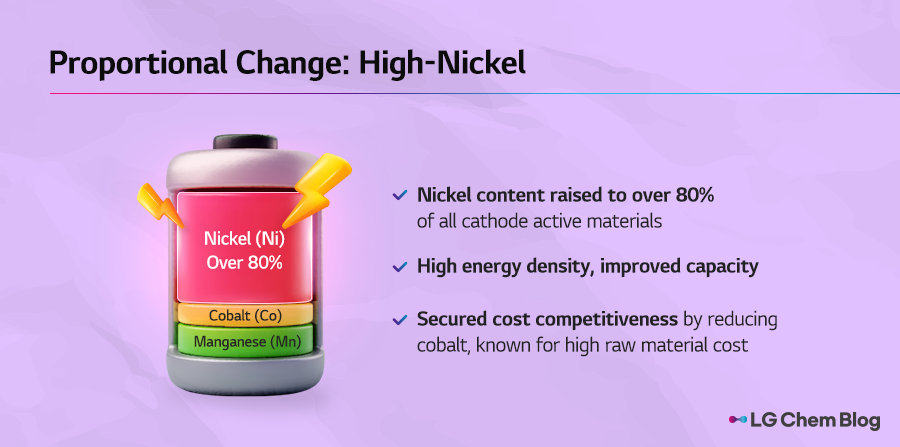 What is a Single-Crystal High-Nickel Cathode (Active) Materials? Let’s look at the term “High-Nickel” first.
Cathode (Active) Materials are subdivided into NCM, NCMA, NCA, and LFP, depending on which cathode active material they contain. Among these types, EV batteries commonly use NCM, which consists of Nickel (Ni), Cobalt (Co), and Manganese (Mn). High-Nickel cathode (active) materials gained their name by lowering the proportion of cobalt and raising the nickel content to over 80%. For instance, NCM811 is a High-Nickel cathode (active) material that contains Nickel, Cobalt, and Manganese in an 8:1:1 ratio.
While Manganese and Cobalt determine the safety of a cathode (active) material, Nickel is a metal that determines its capacity. The higher the Nickel content, the greater the number of lithium ions that can move through the lithium layer compared to other metals. Therefore, high nickel content increases energy density, improving battery capacity.
Another great advantage that High-Nickel cathode (active) materials offer is reduced production cost. Cobalt has the highest cost among all battery raw materials. By lowering the cobalt content, manufacturers can hedge against raw material price fluctuations and secure cost competitiveness.
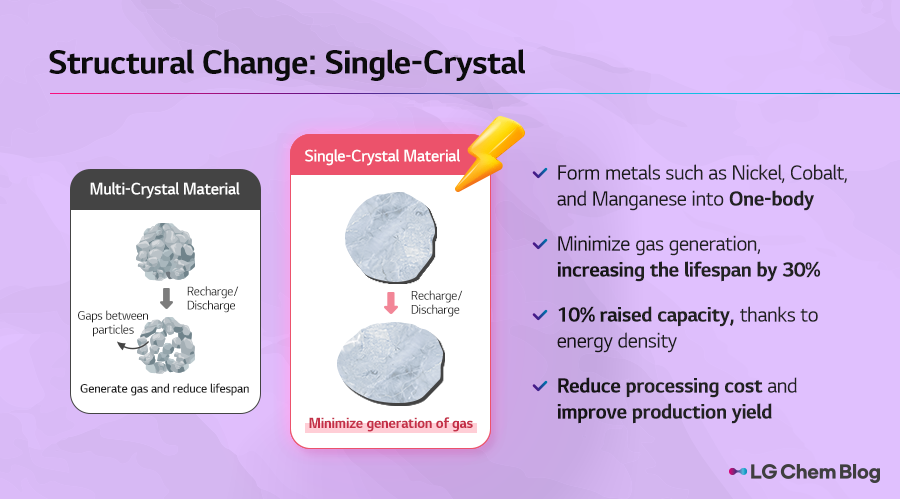
Next, what is a Single-Crystal Cathode (Active) Material? It refers to a material that contains different metals such as Nickel, Cobalt, and Manganese, formed into one body. Also called a Single-Particle Cathode (Active) Material, it is considered a game-changer for solving the issues of battery lifespan and capacity, which are the core challenges of next-generation batteries.
Conventional cathode (active) materials had a multi-crystal (multi-particle) structure made by joining small metal particles. However, with repeated charging and discharging, gaps formed between particles, generating gas and shortening battery lifespan. At times, this also caused battery swelling.
Single-Crystal cathode (active) materials, however, are made by joining numerous metal particles into one body. Since they generate less gas, they offer higher safety and extend battery lifespan by about 30%. On top of that, they have more than 10% increased capacity, as Single-Crystal cathode (active) materials have higher density compared to conventional ones. For example, let’s say an EV using conventional cathode (active) materials runs 500 km per charge. With the same-sized and same-weight battery made of Single-Crystal cathode (active) materials, the range increases to over 550 km.

In short, Single-Crystal High-Nickel Cathode (Active) Materials are next-generation battery materials with improved capacity and lifespan. They maximize the nickel content among all metals that form a cathode (active) material (Proportional change: High-Nickel). In addition, these metals are formed into a one-body structure (Structural change: Single-Crystal).
LG Chem’s Single-Crystal High-Nickel Cathode (Active) Materials Make Their Way to the World

In June 2023, LG Chem began Korea’s first mass production of Single-Crystal High-Nickel Cathode (Active) Materials. At the initial stage of production, which takes place in Cheongju, Korea, the company plans to produce Single-Crystal cathode (active) materials and conventional cathode (active) materials at a 2:8 ratio and gradually transition to 100% Single-Crystal cathode (active) material production. The application will also start with pouch-type products and diversify to 4680 cylindrical batteries (diameter 45 mm, length 80 mm), among others.
Today, we focused on the next-generation battery material, Single-Crystal High-Nickel Cathode (Active) Materials. Please continue to support LG Chem and its Single-Crystal High-Nickel cathode (active) materials as the company expands its leadership in the global battery materials market.





There are no comments yet! Be the first to let us know your thoughts!