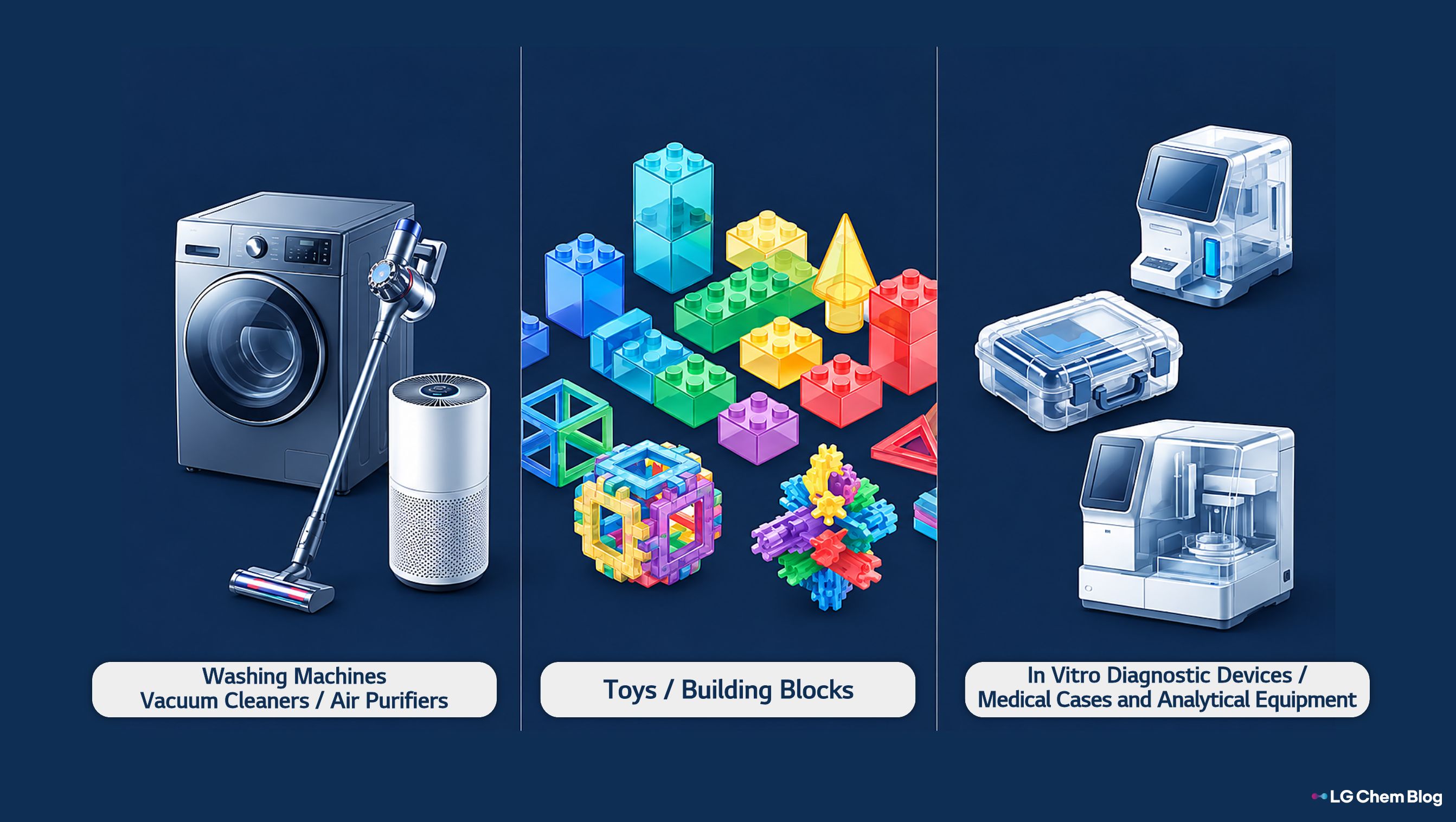
ABS is one of the most widely used plastics in our daily lives. It is used in a wide range of products, from home appliances such as refrigerators and washing machines to toys, household goods, and automotive parts. It is valued for being tough yet easy to process, and for its ability to deliver vibrant colors. This is why many of the brightly colored appliances and toys we see are made of ABS.
So, can ABS be made transparent as well?
Because of its structural characteristics, standard ABS is difficult to make transparent. For this reason, the industry has long worked on technologies to achieve a transparent appearance, and LG Chem has earned recognition for the strong competitiveness of its products in the transparent ABS market, built on its differentiated technology and quality.
The Secret of Transparent ABS: Technology That Reduces Invisible Boundaries
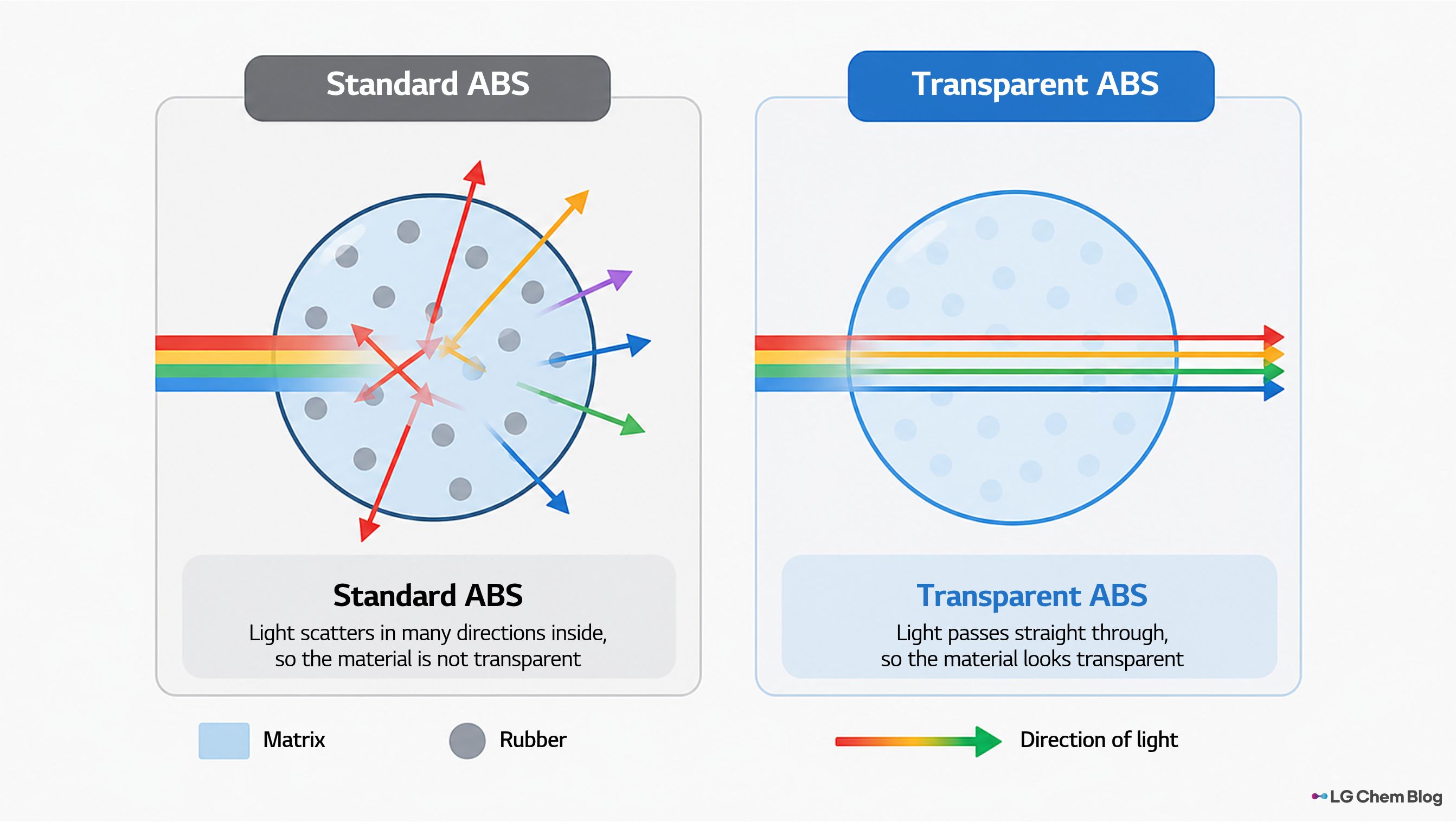
To understand transparent ABS, we first need to look at what makes plastic transparent.
Standard ABS has a structure in which tiny rubber particles are dispersed within a rigid plastic (matrix). Though invisible to the naked eye, the two materials exist as distinct phases, meaning regions with different material properties. Just as water and oil do not mix, plastic and rubber each form their own separate regions.
At the boundaries where these two materials meet, light scatters in many directions. This makes the material look cloudy or opaque. Transparent ABS reduces this light scattering by matching the refractive indices of the plastic and rubber as closely as possible. In standard ABS, the plastic has a refractive index of 1.570 and the rubber 1.515, leaving a gap between the two phases, whereas conventional transparent ABS brings the refractive indices of both materials to around 1.515. As a result, less light is scattered at the boundaries between the two materials, and light can pass through the material, creating a transparent appearance. It is much like seeing the outside clearly through a clean glass window.
The key to transparent ABS lies in technology that precisely controls the refractive indices of the different phases so that the boundaries between them do not show.
What Customers Value Today: Quality, Cost, and Supply Reliability
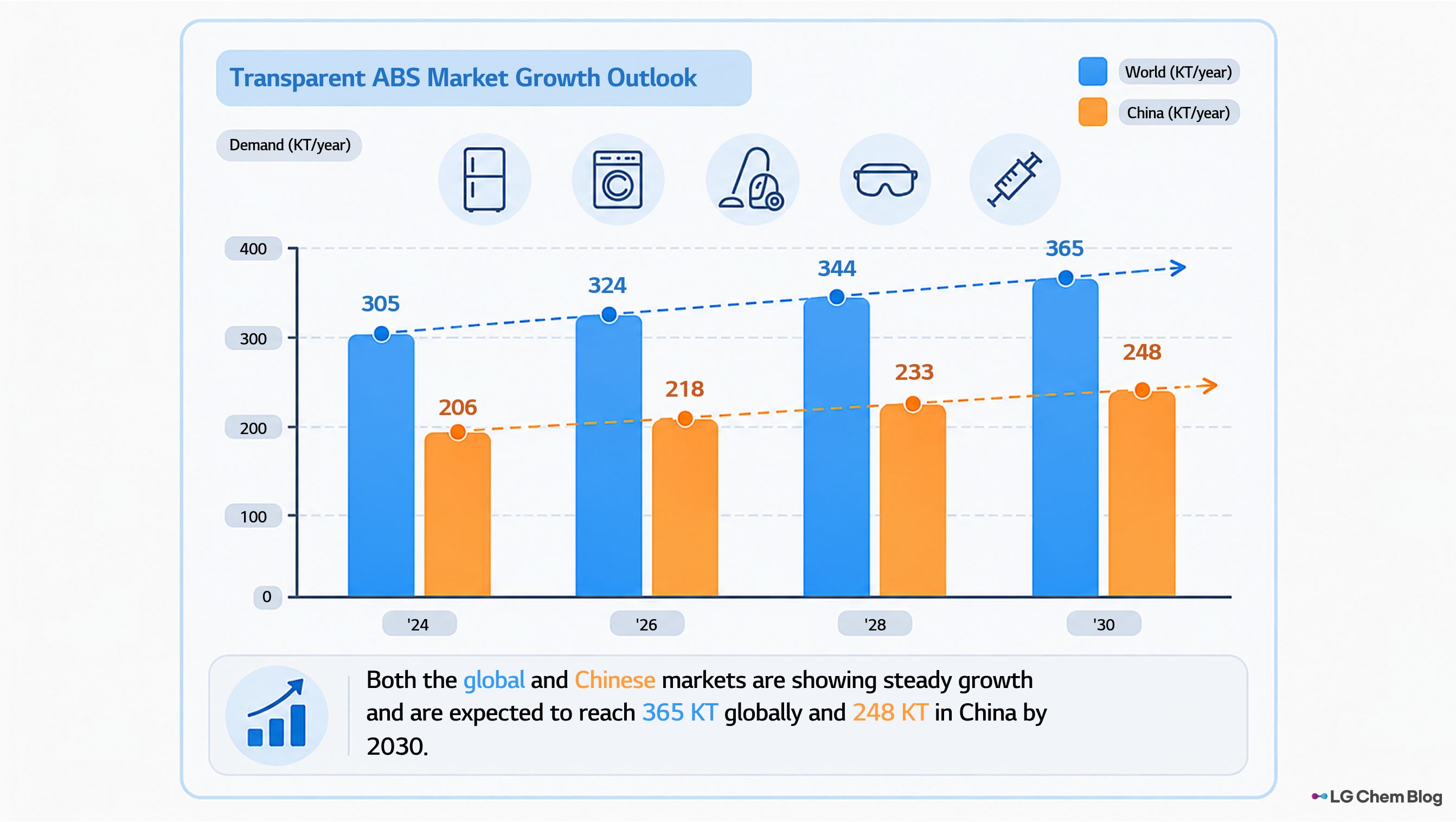
LG Chem’s transparent ABS has long been well regarded in the premium home appliance and medical markets. Its strengths have been a clear, clean appearance, outstanding quality, and customer trust built over many years. Recently, however, the market environment has been changing significantly. As competition in transparent ABS technology rapidly advances in the global market, securing differentiated competitiveness is becoming increasingly important.
The criteria customers use to choose products have also changed. Where they once prioritized “top-tier quality,” they now take “sufficient quality” as a given and also evaluate price competitiveness and the ability to provide a stable supply. In short, what matters now is balanced competitiveness across quality, price, and supply stability.
A Different Approach to Transparent ABS
Until now, it has been common practice in the transparent ABS industry to use large amounts of MMA (Methyl Methacrylate) to make clearer, more transparent products. MMA is a material that plays an important role in achieving a transparent appearance by bringing the refractive indices of the plastic and rubber closer together.
Using more MMA can increase transparency, but it can also affect the material’s physical properties, such as impact strength and heat resistance. That is why it is important to strike a balance between transparency and other aspects of performance.

LG Chem developed the world’s first proprietary transparent ABS platform based on its medium-particle-size SBR* technology, which optimizes the structure of rubber particles.
Neo Clear transparent ABS, built on this platform, significantly reduces the use of MMA while maintaining the same level of transparency and impact resistance as existing products.
*Medium-particle-size SBR (Solution Butadiene Rubber): A synthetic rubber technology that optimizes the size of rubber particles to achieve a balance between transparency and impact resistance.
The development process involved a great deal of trial and error. A single experiment often took more than 24 hours, so researchers had to take turns monitoring the reaction. Researchers spent countless hours monitoring reactions and fine-tuning conditions to capture even the smallest changes.
Successfully matching the refractive indices did not mean development was over. Even after transparency was achieved, if the target strength or heat resistance fell short of expectations, the structure and composition had to be adjusted again. This process was repeated until the desired balance of performance was found.
New challenges also awaited at the trial production stage. Because Neo Clear transparent ABS has a different refractive index from existing products, even a very small amount of an existing product mixed in during production could affect its transparency. To replicate the lab results on actual production equipment, the team thoroughly checked the process ahead of trial production and carefully controlled production conditions to minimize any impact from existing products.
As a result, the proportion of MMA used in the product was lowered from about 60% to around 44%. Transparency and impact resistance remained on par with existing products. Haze, which indicates how cloudy a product looks, was also improved, resulting in an even clearer and cleaner appearance.
The Difference Customers Notice: Cost and Appearance Quality
Reducing MMA use also matters for cost competitiveness. MMA is a material strongly affected by crude oil and raw material market conditions. Using less of it can ease volatility in manufacturing costs. Lower dependence on a specific raw material also reduces the risks posed by supply shortages and market fluctuations, and helps secure a more stable supply chain.
Another focus was reducing variation in appearance quality. With conventional transparent ABS, color sometimes varied from one production lot to another, or color and transparency changed depending on the customer’s production conditions. This was a concern for customers who are particularly sensitive to appearance quality.
Neo Clear transparent ABS was designed to reduce lot-to-lot color variation and to maintain consistent appearance quality even when production conditions change. Color differences depending on the viewing angle were also reduced, and the material was improved so that its appearance does not change in hot and humid environments or at low temperatures.
This allows customers to produce products of more reliable and consistent quality, while end consumers can enjoy products with a cleaner appearance.
Taking On the Medical Market
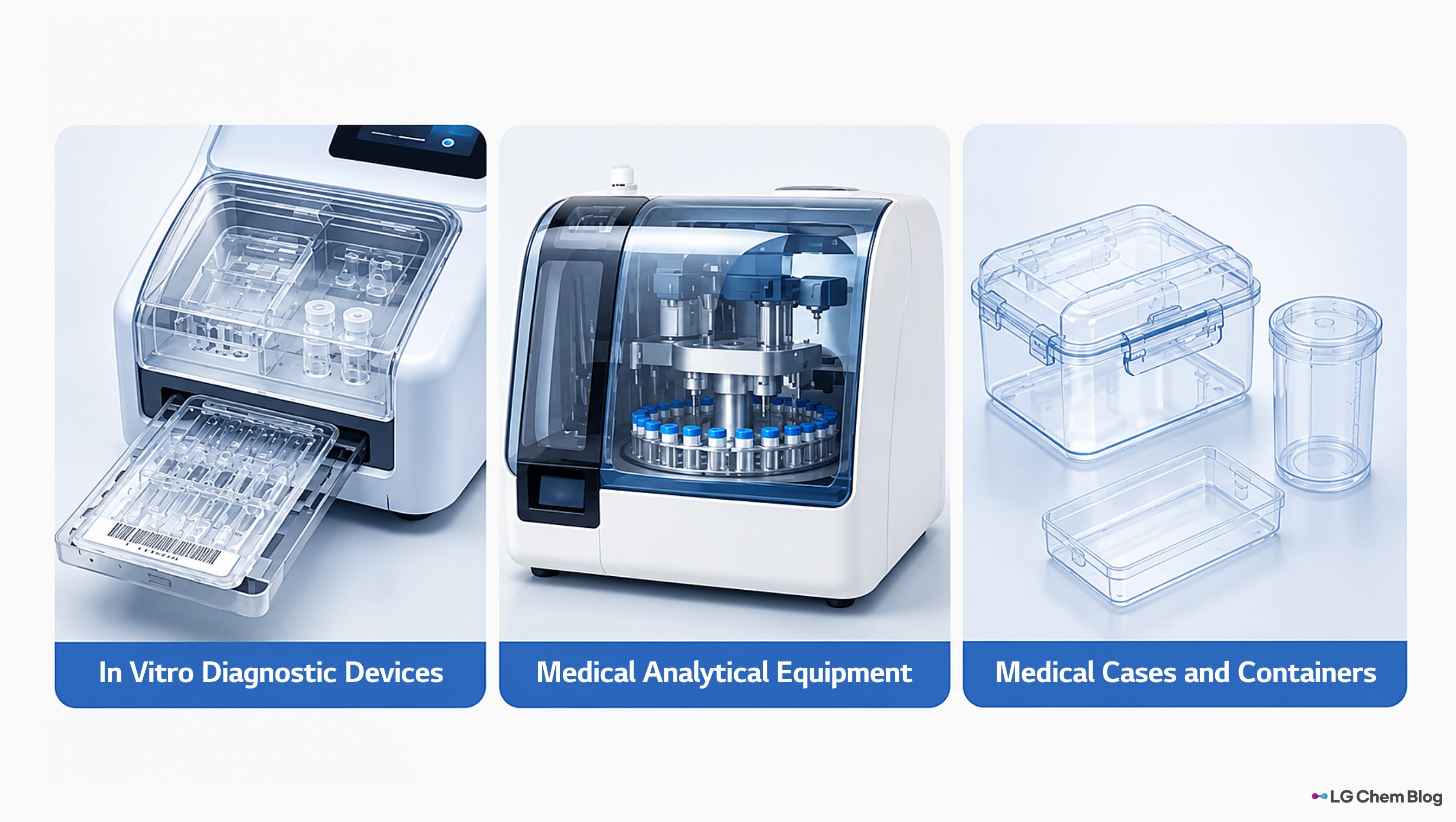
The medical market is currently a particular focus for Neo Clear transparent ABS.
Medical devices often undergo strict hygiene procedures during use, such as alcohol disinfection and gamma sterilization. With continued exposure to these conditions, conventional transparent ABS can discolor or develop a whitened surface.
Neo Clear transparent ABS offers greater resistance to alcohol, along with improvements in both the degree of discoloration after gamma sterilization and the speed of recovery. Based on these properties, its potential applications are expanding, from in vitro diagnostic devices that analyze samples such as blood and urine to medical analytical equipment, cases, and containers. In this way, it addresses the needs of the medical field, where high reliability and appearance quality are required.
Neo Clear transparent ABS aims to provide medical device manufacturers with reliable quality and design flexibility, and to help them develop products of more reliable quality.
Backed by excellent quality, technology, and customer trust, LG Chem’s transparent ABS has led the market. Neo Clear transparent ABS builds on this by adding cost competitiveness, supply stability, enhanced quality, and the reliability required in the medical field. Its significance lies in helping customers produce products of more reliable and consistent quality.
Amid a rapidly changing competitive landscape, LG Chem is setting a new benchmark in the transparent ABS market through its proprietary transparent ABS platform.
Neo Clear is the result of addressing the performance, cost-efficiency, and supply stability of transparent ABS together. LG Chem will continue to offer new value through material innovations that reflect changes in the market and customer needs.
Written by: JongJu Lee, Professional, TAD Project.ABS
※Some images in this content were generated using AI.





There are no comments yet! Be the first to let us know your thoughts!